Readiness Report | June 2026
The Agentic Blind Spot: Why AI Resilience Demands a System of Record
Your AI stack has a recovery problem you probably can’t see yet. This Readiness Report gives CIOs and CISOs the framework to close the context gap – before an incident forces the question.
The Reality: Your AI Looks Recoverable. It May Not Be.
Most organizations managing enterprise AI have a model registry, an artifact store, a pipeline configuration manager. Each can confirm its own slice of the picture. None can confirm whether those pieces belong together, and whether they reflect the same operational state, the same moment, the same trustworthy configuration.
That’s the context gap. And it’s why recovery from an agentic AI compromise isn’t a data restoration problem. It’s a coherence problem.
The AI Resilience Readiness Report gives CIOs and CISOs the framework to close it.
Key Insights
What This Report Covers
Agentic AI has crossed a threshold. These systems don’t answer questions anymore. They execute workflows, coordinate with other agents, and act on production systems continuously and autonomously. That architectural shift changes the risk calculus entirely.
This report examines what readiness really means for the agentic enterprise: the four architectural layers most organizations haven’t designed for, the gaps they haven’t yet recognized, and the case for a unified system of record as the foundation for AI resilience.
1 in 5
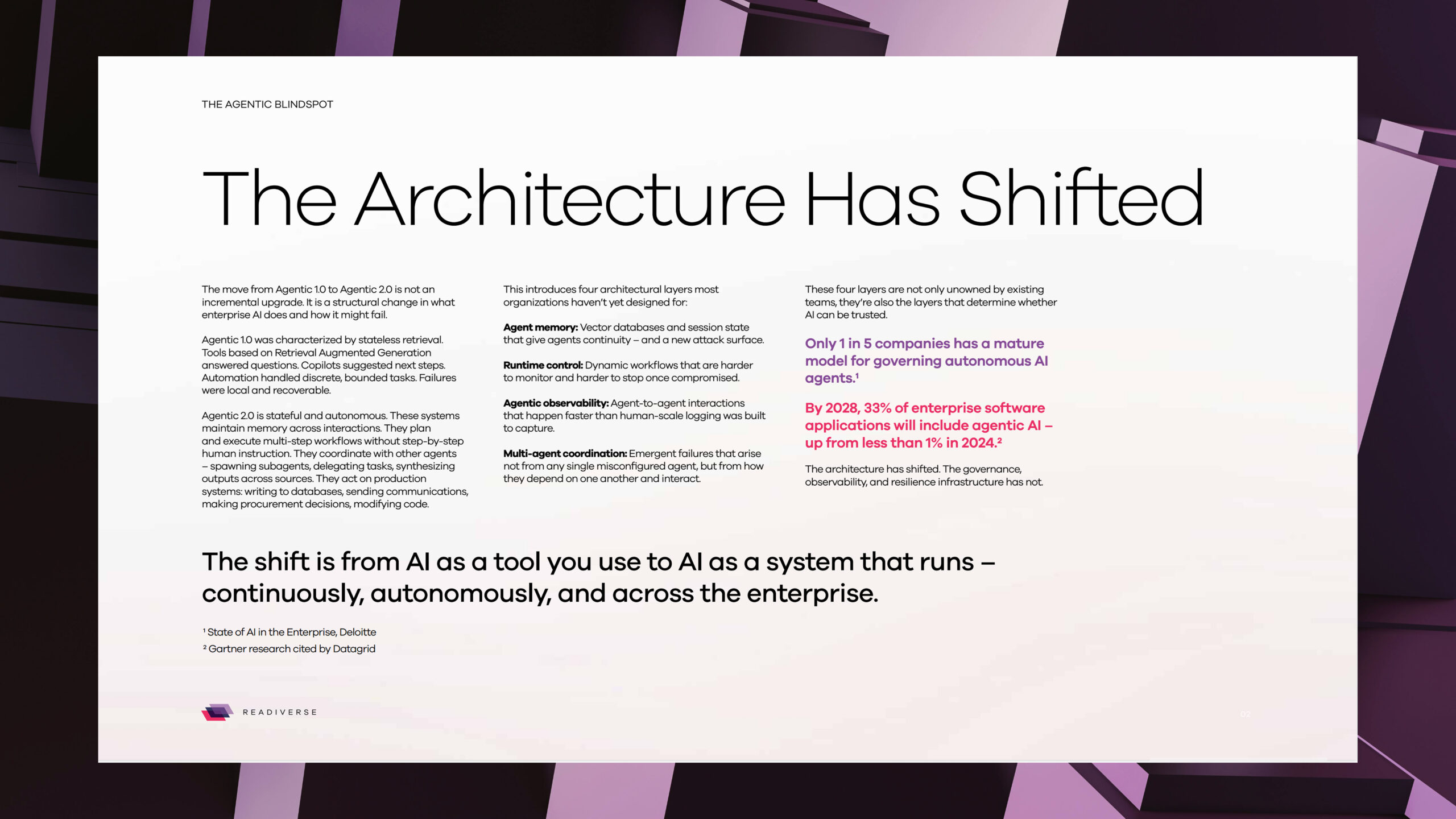
companies has a mature model for governing autonomous AI agents.1
33%
of enterprise software applications will include agentic AI by 2028 – up from less than 1% in 2024.2
79%
of enterprises operate with significant blind spots – agents invoking tools, touching data, or triggering actions outside the scope of any monitoring or governance framework.3
37%
of CISOs cite securing AI agents as their top concern.4
- The State of AI in the Enterprise, Deloitte
- Gartner
- The State of Agentic AI Security 2025, Akto
- 2025 CISO Village Survey, Team8
The Four Dimensions of AI Resilience Readiness
Observability
Can you see what your AI is doing in real time?
Data integrity
Can you prove your AI is running on clean data?
Governance
Does your framework cover what agents do, not just what models say?
Recovery
Can you recover to a verifiable, coherent AI state?
Go Deeper: The Architecture Behind the Risk
The Readiness Report makes the strategic case. This companion piece goes deeper on the four architectural layers – agent memory, runtime control, agentic observability, and multi-agent coordination – that define the actual attack surface of an agentic deployment and explain why existing resilience frameworks fall short.
Recommended for enterprise architects, security engineers, and resilience teams responsible for implementation.
Also in the AI Resilience Series
MCP 2.0 introduced the first real governance framework for AI agents. Seven critical vulnerabilities remain.
The MCP 2.0 AI Security Readiness Report examines what the protocol update solves, what it doesn’t, and how to deploy AI agents safely in enterprise environments – including a 15-question readiness self-assessment.
Recommended for CISOs, enterprise architects, and security teams evaluating agentic AI deployment.
Related Resources

The Four Attack Vectors Your AI Security Framework Isn’t Built For
Agentic AI introduces new security risks because it plans, remembers, and acts across systems instead of stopping after a single prompt-response cycle.

AI: Agents of Good, Meet Agents of Evil
Dr. Blackman introduces his Ethical Nightmare Challenge, a practical framework to help organizations identify the worst-case AI outcomes, build resources to prevent them, and train teams to use safeguards effectively — before complexity spirals into failures.

AI agent security: New governance framework shows progress, but critical gaps remain
The challenge isn’t just what AI agents can do. It’s establishing the governance frameworks to control how they do it.

Join the Readiverse CXO Exchange
Join an exclusive community of CxOs building cyber resilience strategies that anticipate threats and accelerate readiness.